AI Agents in Digital Marketing: How They Are Changing Business in India
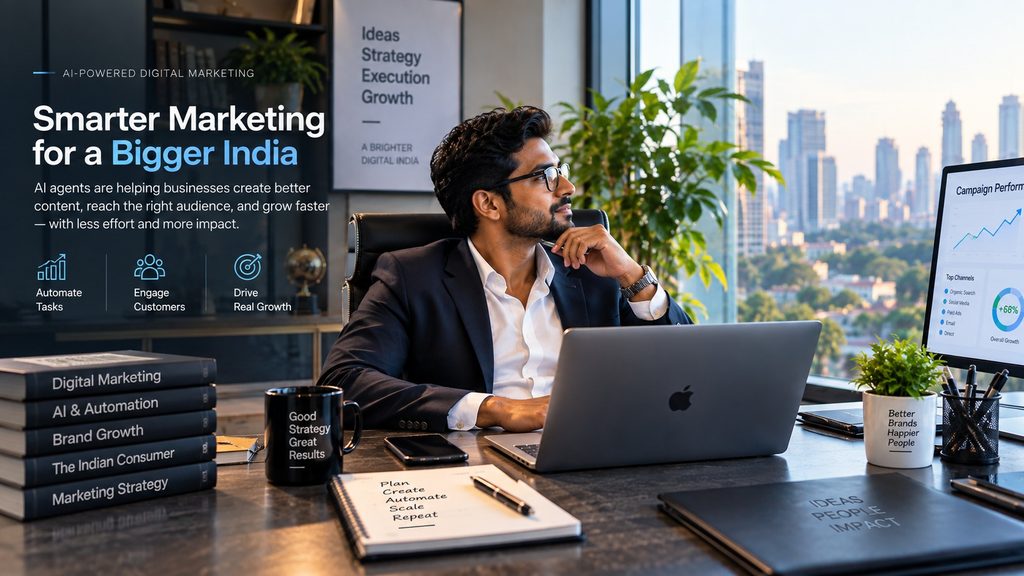
AI agents in digital marketing are changing how businesses research, plan, create, and manage their marketing activities. Instead of using AI only for simple content generation, businesses can now explore AI-assisted workflows that support research, content planning, customer engagement, advertising, analytics, and repetitive marketing tasks. For Indian businesses operating across multiple channels and customer segments, these workflows can help marketing teams organise their work more efficiently.
Artificial intelligence is becoming an important part of modern business strategy. Companies are exploring AI not only to create content but also to support multi-step processes that traditionally required several manual activities. This shift is helping marketers rethink how they approach SEO, social media, paid advertising, content marketing, and customer communication.
What Are AI Agents in Digital Marketing?
An AI agent is a software system designed to work toward a specific goal by understanding instructions, planning tasks, and carrying out multiple steps with the tools available to it.
A simple AI workflow may look like:
Prompt → Response
An agent-based workflow can be more involved:
Goal → Research → Plan → Execute → Review
For example, a marketing team may want to research a new topic, organize keyword opportunities, prepare a content brief, create social media ideas, and summarize the findings. An AI-assisted workflow can help organize these steps into a more structured process.
The exact capabilities depend on the AI platform, connected tools, permissions, and business workflow. Important business decisions should still be reviewed by a human.
Why AI Agents Matter for Indian Businesses
India has a highly diverse digital market. Businesses may target customers across different cities, languages, industries, age groups, and purchasing stages.
A digital marketing team may manage:
- Search engine optimization
- Social media marketing
- Google Ads
- Content creation
- Email marketing
- WhatsApp communication
- Customer support
- Marketing analytics
Managing all these activities manually can take significant time.
AI-assisted workflows can help teams organize repetitive and research-heavy activities while allowing marketers to focus more on strategy, creativity, and customer relationships.
For a small business, this could mean spending less time on repetitive work and more time understanding customers and improving the overall marketing strategy.
How AI Agents in Digital Marketing Can Support SEO
SEO requires continuous research and optimization.
Marketing teams often need to review:
- Search queries
- Keyword ideas
- Search intent
- Competitor content
- Content gaps
- Internal linking opportunities
- Search performance
AI can help organize this information into a repeatable process.
For example:
Business topic → Keyword research → Search intent → Keyword clustering → Content brief
An AI agent can assist with organizing the research, while an SEO professional validates actual search demand, competition, search results, and business relevance.
Businesses can combine this approach with professional SEO services to develop a structured and data-driven search strategy.
AI Agents in Digital Marketing for Content Marketing
Content marketing is no longer simply about writing as many articles as possible.
Businesses need to create content that answers real customer questions and supports specific marketing goals.
AI can assist with:
- Blog topic ideas
- Content calendars
- Content briefs
- FAQ ideas
- Social media content
- Email topics
- Content repurposing
For example, one detailed article about local search can become a LinkedIn post, Instagram carousel, short video script, email topic, and FAQ.
This makes content repurposing easier and helps businesses maintain a consistent publishing schedule.
However, AI-generated content should still be reviewed for accuracy, originality, brand voice, and usefulness before publication.
AI Agents in Digital Marketing for Social Media
Social media teams often have to create content regularly for several platforms.
A typical workflow can include:
Topic research → Post idea → Caption → Visual concept → Publishing → Performance review
AI can help with brainstorming, drafting, organizing, and repurposing content.
For example, a business can provide one campaign idea and develop different versions for:
Instagram → Facebook → LinkedIn → Short-form video → Email
This can save time while maintaining a consistent campaign message.
Human creativity still matters because audiences respond to authentic stories, relevant experiences, and content that reflects the real brand.
AI Agents for Google Ads and Paid Marketing
Paid advertising requires planning, testing, monitoring, and optimization.
AI can support tasks such as:
- Ad headline ideas
- Description variations
- Audience messaging
- Landing-page content ideas
- Campaign themes
- Testing concepts
- Performance summaries
For example, a business running Google Ads may create several message variations for different customer groups.
AI can help with the initial ideas, while marketers can decide which messages are appropriate based on campaign goals, actual data, budget, and audience needs.
A practical workflow is:
AI recommendation → Human review → Approval → Campaign execution → Measurement
This provides efficiency without removing human responsibility from important advertising decisions.
AI Agents in Digital Marketing for Customer Engagement
Customer communication is another area where AI can support businesses.
Customers may ask questions about:
- Services
- Pricing
- Availability
- Delivery
- Appointments
- Product information
- Support
AI-assisted workflows can help businesses respond to common questions more quickly.
For example:
Customer question → AI-assisted response → Lead capture → Human follow-up
This can be especially useful for businesses that receive a high volume of customer enquiries.
Complex questions, complaints, sensitive issues, and important customer decisions should still be handled with appropriate human oversight.
Personalization for Different Audiences
Not every customer wants the same message.
An Indian business may have different audiences based on:
Location → Industry → Age → Interests → Buying stage
For example, a digital marketing agency may communicate differently with a startup founder and a local retail business owner.
AI can help adapt a central marketing message for different audiences.
A useful framework is:
Audience + Customer problem + Business solution + Brand voice + Call to action
This can help marketers create more relevant messaging while keeping the overall brand positioning consistent.
Regional and Multilingual Marketing in India
India’s multilingual environment creates opportunities for businesses to connect with more customers through regional content.
A company may want to communicate with audiences using English, Hindi, Tamil, Telugu, Malayalam, Bengali, and other languages.
AI can help marketers draft and adapt content faster.
However, translated content should be reviewed for:
- Meaning
- Tone
- Context
- Local expressions
- Accuracy
Direct machine-generated translations should not automatically be treated as publication-ready, particularly when the message is customer-facing or commercially important.
Data Analysis and Marketing Reporting
Marketing teams generate large amounts of data.
They may monitor:
- Website traffic
- Organic search performance
- Ad results
- Social media engagement
- Leads
- Conversions
- Customer interactions
AI can help organize and summarize this information.
Instead of simply producing a report, an AI-assisted workflow can help marketers ask:
What changed?
Which channel changed?
What should be investigated?
Which activity needs optimization?
This can make reporting more useful for marketing teams.
However, the underlying data should always be checked before making important business decisions.
AI Agents in Digital Marketing for Task Automation
One of the most practical applications of AI agents is repetitive work.
Consider a weekly reporting process:
Collect data → Organize information → Prepare summary → Create report → Share findings
AI can potentially assist with several steps depending on the tools and integrations available.
Other repetitive activities may include:
- Updating marketing documents
- Organizing campaign information
- Preparing content calendars
- Summarizing customer feedback
- Creating recurring reports
- Sorting research notes
Automation should be introduced gradually, particularly when workflows involve customer data, financial information, advertising budgets, or external publishing.
Human and AI Collaboration
The future of digital marketing is not simply about choosing between humans and AI.
A more practical approach is:
Human strategy + AI assistance
Humans can focus on:
- Brand strategy
- Creative direction
- Business positioning
- Customer relationships
- Fact checking
- Budget decisions
- Final approval
AI can assist with:
- Research
- Organization
- Drafting
- Repetitive tasks
- Data summarization
- Workflow coordination
This combination allows businesses to explore automation while preserving human judgment.
Challenges Businesses Should Consider
AI agents can provide useful support, but businesses should also understand the limitations.
Accuracy
AI systems can sometimes produce incorrect information. Important facts should be verified before publication or use.
Data Privacy
Businesses should be careful when handling customer, financial, confidential, or sensitive information.
Security
Connected tools and automated workflows require appropriate access controls and security practices.
Human Oversight
Important decisions should include clear approval processes.
Business Value
The goal of automation should not simply be “using AI.” Businesses should measure whether the workflow improves productivity, quality, customer experience, or business performance.
A Practical AI Marketing Workflow
Businesses can start with a small workflow rather than attempting to automate everything.
Step 1: Identify a repetitive task
Choose something that happens frequently.
Step 2: Define the business goal
For example, reduce the time required to prepare weekly marketing reports.
Step 3: Build the workflow
Create a clear sequence of research, organization, execution, and review.
Step 4: Add human approval
Decide which steps require a person to review the output.
Step 5: Measure performance
Track time saved, quality, productivity, and business impact.
Step 6: Improve gradually
Once the workflow works reliably, consider expanding it to other marketing activities.Once one workflow is reliable, consider connecting additional marketing tasks.
Final Thoughts
AI agents are changing digital marketing in India by moving AI from simple content assistance toward multi-step workflows.
A strong website foundation also requires proper Technical SEO.
India’s enterprise AI adoption is already moving beyond experimentation in several functions, while research from Deloitte and EY points toward increasing use of agentic systems and human-AI collaboration.
The practical goal is not to automate every marketing decision. It is to identify repetitive or research-heavy processes where AI can provide useful assistance while people remain responsible for strategy, accuracy, trust and final decisions.
The future of digital marketing is increasingly likely to be a collaboration between human marketers and capable AI systems.